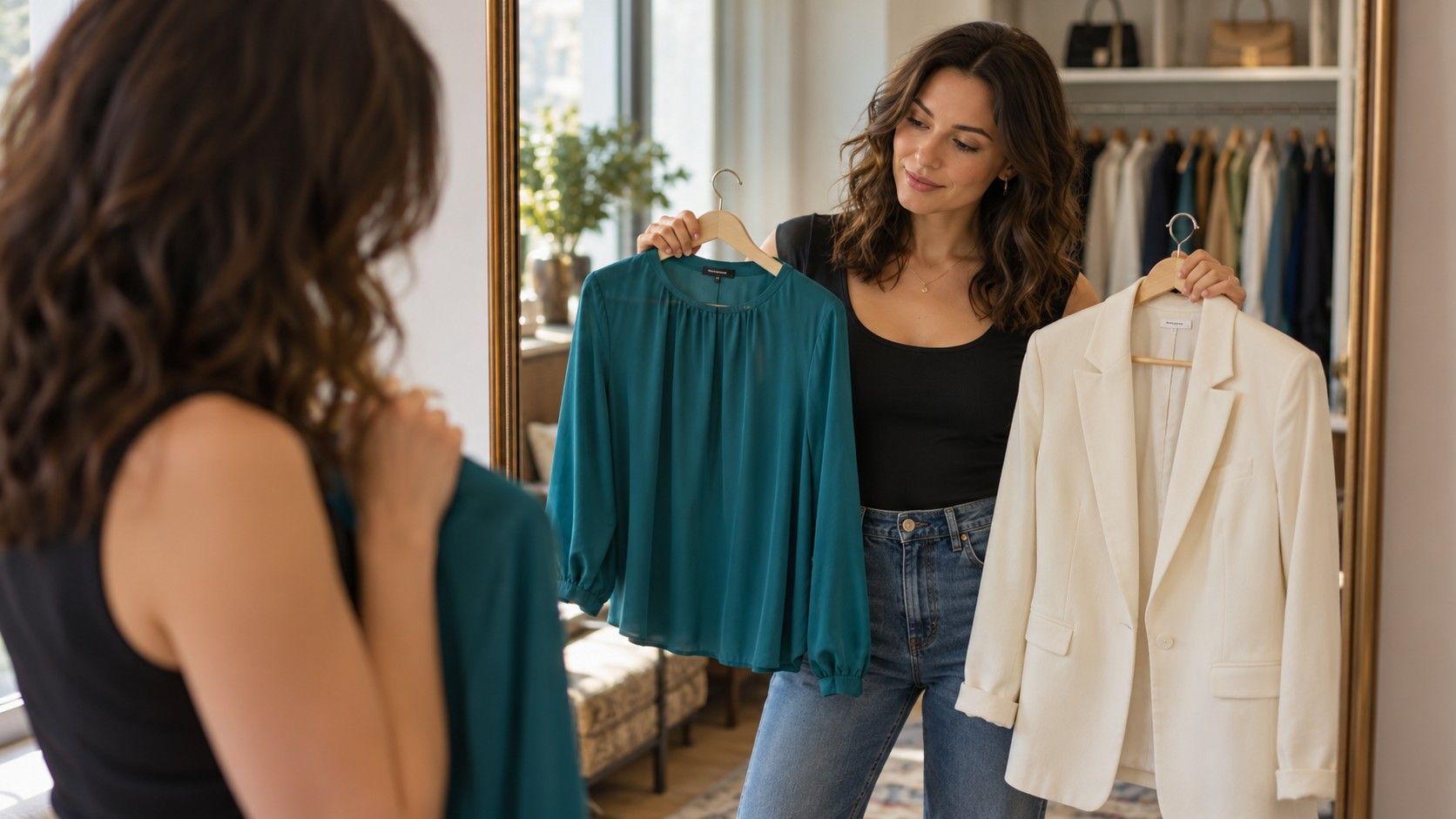
Soft Natural summer outfits are easiest to build when the clothes feel good in heat before they satisfy a style checklist. I start with room to move, fabric that falls comfortably and a few proportions worth comparing. The aim is a wearable wardrobe for your actual days, using the style system as a source of ideas rather than a verdict on your shape.
Start with the walk to lunch, not the mirror
A summer outfit can look pleasantly relaxed while you stand still and feel restrictive after ten minutes outside. Before deciding whether a blouse suits a Soft Natural mood, reach forward, sit down and lift your arms. Watch the fabric across the upper back and the position of the armholes. If the whole top rises whenever you reach for a bag, its cut may be the problem. Buying a larger size sometimes adds unwanted length without solving that restriction.
I treat Soft Natural as an optional vocabulary for an outfit: a little softness, some movement and an unforced shape. It is a style idea, not a diagnosis or a requirement attached to your body. Summer here means warm weather, rather than the Summer family in seasonal color analysis. You can use any palette you enjoy. The immediate task is to find clothes you can wear comfortably on the bus, at a desk and on a warm pavement.
Check a neckline while bending to pick something up, and check a skirt while taking a normal stride. A wrap front may need a small stitch or a camisole; a narrow hem may need a vent. These are construction questions rather than evidence that an outfit belongs to the wrong style category. I would rather make one useful alteration than replace a garment because a list of recommendations excludes it.
Choose drape that survives an ordinary afternoon
Thin fabric and breathable fabric are different things. A light cloth with a dense weave can still feel close, while a slightly heavier open weave may let more air through. Hold a candidate shirt up to the light, rub it gently between your fingers and look at the care label. Fiber, weave, finish and lining all affect how it wears. Linen, cotton, viscose and blends can each work, but their names alone do not tell you how a particular garment will behave.
For a soft silhouette, try a blouse that falls from its seams without becoming clingy. A linen blend may give a little structure at the shoulder while moving around the waist. A fluid woven skirt can offer movement without the close fit of a thin jersey one. Sit in each for a minute before judging. Fabric that seems substantial on a hanger can become transparent where it stretches across the seat.
Wrinkles need a realistic decision. If you dislike pressing clothes, an extremely crisp linen shirt may frustrate you even if you love its shape. Scrunch an inconspicuous corner in your hand and see how it recovers. Consider the actual washing routine too. A delicate garment that needs special care is a poor everyday choice when your summer laundry usually goes through one shared machine load.
Give shorts and tops enough space to work together
With shorts, I check the rise and leg opening before thinking about length. Sit on a chair and notice whether the waistband folds into you or the hem cuts into the thigh. Walk a few steps to see whether the legs ride up. Pleats, a shaped waistband or a different cut may help, but none is automatically the answer. Two pairs labelled with the same size can fit very differently through the seat.
A softly shaped shirt with straight shorts is an easy starting point. Try it fully loose, with a small front tuck and with the hem folded temporarily to a shorter length. Each version changes where the eye pauses. If the tuck pulls the shirt tight across the back, release more fabric or skip it. Defining a waist is a preference, not an obligation. A loose column can feel just as intentional when the neckline, sleeves and footwear are considered.
Photograph the same combination from the same distance, using ordinary daylight. Compare how it feels as well as how it looks. A shorter top may leave you adjusting it every time you reach upward; a longer one may catch inside a jacket. Soft Natural summer outfits become easier when you keep these small observations. They explain more than a rule that every hem must stop at one supposedly ideal point.
Use a dress when one decision is enough
A dress can simplify a hot morning, provided it does not introduce three new fit problems. Try a softly gathered waist, an easy shirt dress or a bias-cut shape as possibilities. Inspect the closure while sitting, especially between the buttons at the bust and hip. With a slip style, walk toward the light to check coverage. If you need a slip underneath, include it in the fitting test because that extra layer changes the temperature and movement.
For a relaxed effect, a dress can have shape through a seam or a tie without being tightly cinched. Loosen the tie by an inch and compare the result. Sometimes the neckline and fabric already provide all the softness the outfit needs. If a full skirt tangles around your legs on a windy commute, a straighter skirt with enough walking room may serve you better. Practical comfort can guide the silhouette.
Shoes deserve a separate trial. Wear the sandals or trainers you actually plan to use, then check whether the hem catches on them or needs constant lifting on stairs. Flat shoes do not require a particular dress length. The useful relationship is between hem movement, walking speed and the places you visit. A long dress that feels lovely indoors may be awkward on a bicycle or around station escalators.
Keep an indoor layer that fits the whole outfit
An air-conditioned office can make a sleeveless summer outfit feel unfinished for entirely practical reasons. Put a light cardigan, soft jacket or open shirt over it before leaving home. Look at the shoulder seams of both layers. A close jacket over a loose blouse often bunches at the upper arm; a slightly roomier sleeve may sit more comfortably. Test the combination with your bag on your shoulder, since a strap can expose bulk that the mirror misses.
A layer does not have to be short to acknowledge the waist. An open shirt can show the shape of the clothes beneath it, and a fluid jacket can fall alongside a dress. Keep the fronts free and compare them with the same layer fastened. If the outfit feels busy, remove a competing detail rather than assuming you need a new jacket. A large collar, gathered sleeves and a scarf can simply be too much fabric for your current mood.
| Situation | Starting combination | Check before leaving |
|---|---|---|
| Warm commute, cool office | Easy trousers, sleeveless top, light cardigan | Cardigan sleeves fit over the top without bunching |
| Long afternoon outside | Loose woven shirt and comfortable shorts | Coverage, airflow and a waistband that works seated |
| Dinner after a daytime outing | Simple dress and an open soft jacket | Hem movement and shoes comfortable enough for both |
The table gives starting combinations, not dress codes or promises about appearance. For strong sun, think separately about shade, suitable coverage and your usual sun protection. A sheer decorative shirt may change an outfit without providing the protection you expect from a covering layer.
Pack around the clothes you reach for twice
For a small summer wardrobe, put two bottoms, three tops, one dress and one indoor layer on the bed. Try every top with both bottoms. You do not need all the combinations to work, but each packed garment should have a clear job. A top that needs a special bra, a particular jacket and your least comfortable shoes consumes more space than its size suggests.
Keep color simple if it helps: two familiar neutrals and one color you enjoy are enough for a trial. This is a packing convenience, not a seasonal color prescription. Add texture through a woven shirt or a softly crinkled skirt if plain pieces feel flat. Then consider the bag and shoes you already own. A comfortable bag strap and shoes that can manage the walking matter more than matching every buckle.
After a week, note which clothes you wore again and which you kept leaving on the hanger. Was the rejected piece too warm, too delicate, too revealing for the setting or simply uncomfortable? Those answers make the next purchase more precise. Keep the Soft Natural label only while it helps you describe what you like. A summer wardrobe has done its job when you can get dressed, move freely and stop thinking about your clothes for a while.